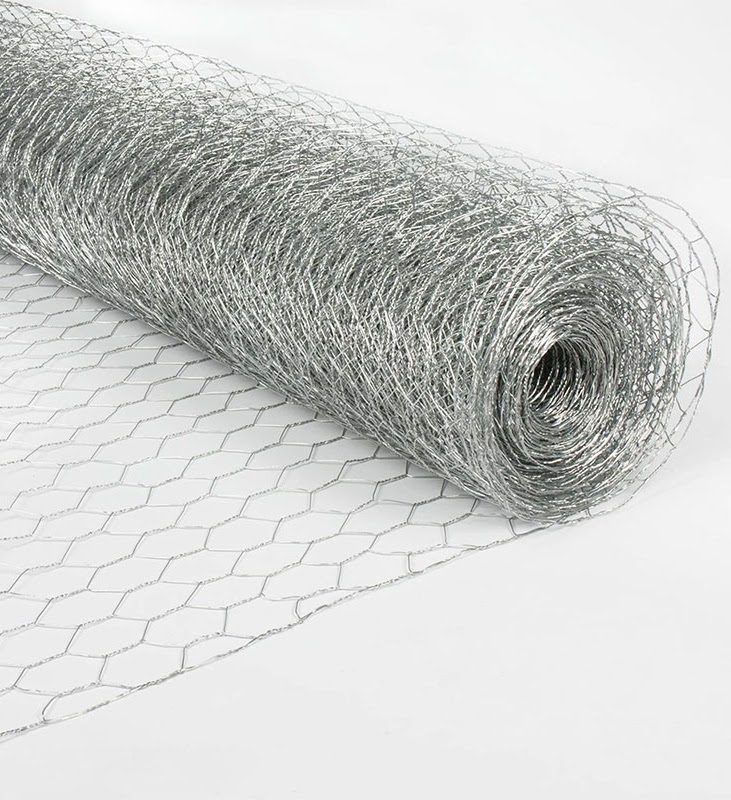
The material every gabion, mattress, sack and drapery panel we make is woven from. Double twisted through three half-turns, so a cut wire cannot unravel the panel. Supplied in rolls it is the same product sold as rockfall netting.
Double twisted hexagonal mesh is made by twisting each pair of adjacent wires around one another through three half-turns before they separate to form the next hexagon. The twist is mechanical, not a weld, so there is no heat-affected zone to corrode and no single joint whose failure opens the panel.
Cut one wire in a welded mesh and the sheet starts to come apart along that line. Cut one wire here and the twists on either side hold; load simply redistributes through the surrounding hexagons. That tolerance is why double twisted mesh is specified for gabions, revet mattresses and rock slope drapery rather than rigid mesh.
We supply it as finished units — see gabion boxes, revet mattresses and rockfall netting — or as plain rolls for fabrication, wrapping and site repairs.
The standard schedule under IS 16014:2024. Any other combination is made to order.
| Parameter | 6×8 mesh (D = 60 mm) | 8×10 mesh (D = 80 mm) | 10×12 mesh (D = 100 mm) |
|---|---|---|---|
| Typical use | Revet mattresses, thin units | Gabion boxes, rockfall drapery | Gabion boxes, rockfall drapery |
| Mesh wire dia (GI) | 2.00 / 2.20 mm | 2.70 mm | 2.70 / 3.00 mm |
| Edge / selvedge wire dia (GI) | 2.40 / 2.70 mm | 3.40 mm | 3.40 / 3.90 mm |
| Lacing wire dia | 2.20 mm | 2.20 mm | 2.20 mm |
| PVC coated mesh wire (ID / OD) | 2.00 / 3.00 mm | 2.70 / 3.70 mm | 2.70 / 3.70 mm |
| Twist | Three half-turns, machine woven | ||
| Mesh opening tolerance | D ±10% on the nominal opening |
What a square metre of mesh and a 25 m roll weigh — the figures we plan production on for 10×12, and estimates for the smaller meshes.
| Mesh | Wire | kg/m² | 25 × 2 m roll (kg) | 25 × 3 m roll (kg) | 25 × 4 m roll (kg) | Basis |
|---|---|---|---|---|---|---|
| 10×12 | GI 2.70 mm | 1.18 | 59 | 88 | 118 | our production figure |
| 10×12 | GI 3.00 mm | 1.41 | 70 | 106 | 141 | our production figure |
| 10×12 | PVC 2.70 / 3.70 mm | 1.36 | 68 | 102 | 136 | our production figure |
| 8×10 | GI 2.70 mm | 1.48 | 74 | 111 | 148 | estimate |
| 8×10 | PVC 2.70 / 3.70 mm | 1.70 | 85 | 128 | 170 | estimate |
| 6×8 | GI 2.20 mm | 1.31 | 65 | 98 | 131 | estimate |
| 6×8 | PVC 2.20 / 3.20 mm | 1.50 | 75 | 113 | 150 | estimate |
We manufacture to your project's drawing and governing standard. Typical parameters we supply against:
| Parameter | Available options |
|---|---|
| Mesh form | Hexagonal, double twisted (three half-turns), machine woven |
| Mesh types | 6×8, 8×10 and 10×12 as standard |
| Wire | Heavily galvanized mild steel, or PVC coated over galvanized |
| Roll width | Made to requirement — commonly 2 m, 3 m and 4 m |
| Roll length | Commonly 25 m; other lengths made to order |
| Selvedge | Heavier gauge edge wire, mechanically bound into the mesh |
| Supplied as | Plain rolls, or fabricated into boxes, mattresses and drapery panels |
| Raw material | Procured to ISI standards from verified manufacturers |
| Quality system | ISO 9001:2015 certified (Cert. No. 305024011282Q); test certificate supplied with every lot |
The reasons engineers write “double twisted” into the specification instead of leaving the mesh type open.
Stone abrades wire, and site damage happens. A severed wire in double twisted mesh stays locked by the twists on either side, so the damage stops where it started.
Embankments settle and river beds scour. Woven mesh deforms with the ground and keeps carrying load where a rigid panel would shear at its joints.
Zinc mass per square metre, not wire diameter, decides how long the structure lasts. We supply to the IS 16014:2024 table above, and PVC over zinc where the works stay wet.
You do not order "mesh" as such — you order the unit the drawing calls for, and we weave the mesh to suit it: boxes, mattresses, sacks or facia units.
Where the mesh is wanted as plain rolls — draped down a rock face, or cut and laced on site — that is rockfall netting. Same mesh, same standard, supplied in 25 m rolls rather than fabricated units. It is not a different product.
Either way, tell us the mesh type, wire diameter, coating and quantity — or just send the drawing and we will read the schedule off it.
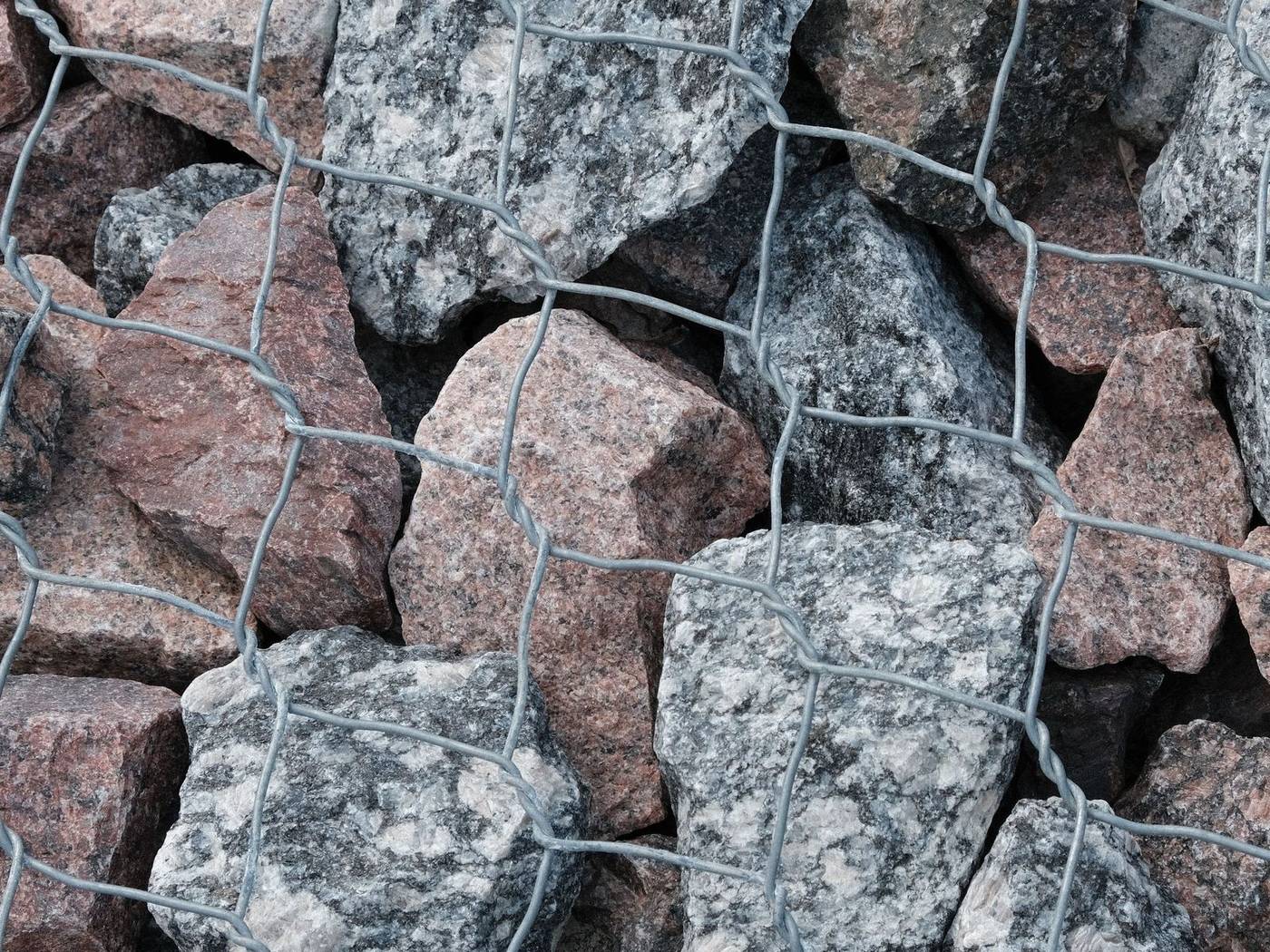
Every gabion application, and which of our units each one needs, is explained on one page.
See how it is used →
See how it is used →
See how it is used →
See how it is used →
See how it is used →
See how it is used →
See how it is used →
For 10×12 mesh: about 1.18 kg/m² in 2.70 mm GI wire, 1.41 kg/m² in 3.00 mm GI and 1.36 kg/m² in 2.70/3.70 mm PVC coated — the figures we plan production on. A 25 × 2 m roll of 2.70 mm GI is about 59 kg. See weights and sizes.
No. Chicken mesh (hexagonal wire netting, IS 3150) is light single-twist netting for poultry and plaster. Double twisted mesh (IS 16014) is heavy 2.00–3.00 mm wire twisted three half-turns, for gabions, mattresses and rockfall netting. We make only the double twisted mesh.
Each pair of adjacent wires is twisted around the other through three half-turns before separating to form the next hexagon. Because the joint is a mechanical twist rather than a weld, cutting one wire does not unravel the panel — the twists either side hold and load redistributes through the surrounding hexagons.
IS 16014:2024 designates mesh by nominal opening D: 10×12 (D = 100 mm) and 8×10 (D = 80 mm) for gabion boxes and rockfall drapery, and 6×8 (D = 60 mm) for revet mattresses and thinner units. The opening tolerance is ±10% of D.
For gabions, mattresses and rock slope drapery, yes — it flexes with ground movement and does not unravel when a wire fails. Welded mesh is rigid and better where a square aperture and a flat, stiff panel are wanted. They are different tools rather than better and worse.
Yes. Rolls are made to the mesh type and wire diameter you specify, commonly 2 m, 3 m or 4 m wide and 25 m long, in GI or PVC coated wire. We also fabricate it into boxes, mattresses and drapery panels to your dimensions.
More on the gabion FAQ page, or ask us directly.
Tell us your dimensions, wire specification and quantity — we'll come back with a quotation and lead time.