Razor wire in a spring steel coil — the fastest deterrent to put on top of a wall, along a fence line or across open ground. We make every common type and size, to the tender clause or to your sample: 450, 500, 600, 730, 900, 980 and 1050 mm coils, short to long blades, galvanized throughout.
Concertina Coil 600 mm, 50 Loops, Galvanized Razor Wire
From ₹999 per coil, incl. GST, ex-works
Final rate depends on size, quantity and delivery point; freight extra. Test certificate with every lot. Get a quotation
A concertina coil is a continuous spring steel core wire clinched inside a galvanized steel tape that has been punched into sharp barbs. Drawn out, it forms a run of overlapping loops; released, it springs back — which is exactly what makes it hard to climb through, cut through or hold open.
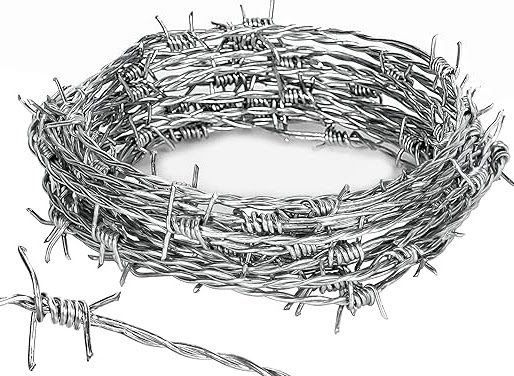
Unlike plain barbed wire, which deters, razor tape is a contact deterrent: the barbs are pressed blades rather than twisted points. It is used where a boundary has to stop people rather than mark a line — substations, depots, warehouses, factory and campus walls, railway and defence installations.
Indian tenders call it concertina coil, punched tape concertina coil (PTCC), razor wire or RBT concertina — it is the same product.
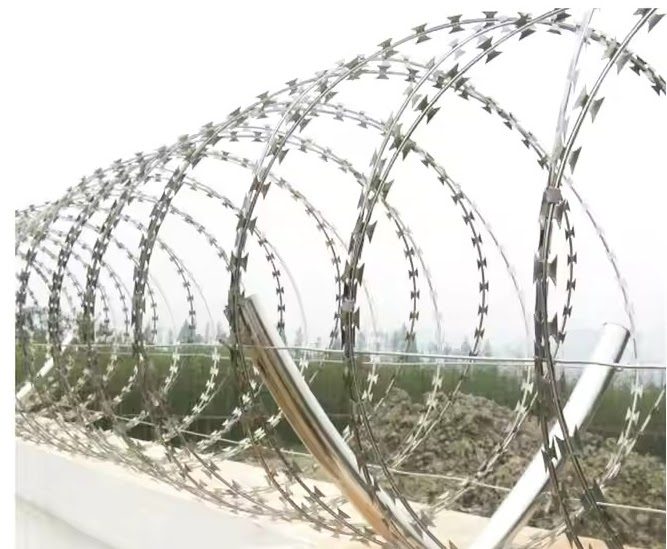
Choose by where it goes and how hard the barrier must be.
| Type | What it is |
|---|---|
| Single coil (spiral) | One helix of razor tape on its core, stretched along the run and held at a set pitch by clips. The standard wall-top coil in Indian tenders. |
| Cross type | Adjacent loops clipped to each other at points round the circumference, so the coil opens into a criss-crossed barrier that is harder to push through. |
| Flat wrap | Loops flattened into a panel that lies close to a wall or fence face — neat where a round coil would overhang. |
| Straight razor tape (RBT) | Razor barbed tape on a core, run straight between posts — the horizontal lines in a Y-angle fence. |
| Double coil | A smaller coil inside a larger one, for a deeper obstacle on open ground. |
The number in the name is roughly the barb length. All on a 2.5 mm spring core.
| Blade | Barb length | Barb spacing | Tape | Where it fits |
|---|---|---|---|---|
| BTO-10 | 10–12 mm | 26 mm | 0.5 mm | Short barb — dense, neat, for wall tops in towns |
| BTO-22 | 22 mm | 34 mm | 0.5 mm | Medium barb — the usual choice for Indian boundary walls |
| BTO-30 | 30 mm | 34 mm | 0.5 mm | Long barb — a harder obstacle for fence lines |
| CBT-60 | 60 mm | 96 mm | 0.6 mm | Long, hooked barb — perimeters and high security |
| CBT-65 | 65 mm | 100 mm | 0.6 mm | Longest barb — defence and prison-grade perimeters |
Most government and PSU tenders use the same item for wall-top concertina fencing. In plain words:
| Part | What the item specifies |
|---|---|
| Coil | Punched tape concertina coil, 600 mm diameter |
| Loops | 50 rounds per 6 m of run |
| Openable length | 10 m per coil (total run as per BOQ) |
| Spring core | 2.5 mm high tensile wire, 165 kg/mm² |
| Tape | 0.52 mm thick, 43.478 g per metre |
| Support | M.S. angle ‘Y’ posts 2.4 m or 3.0 m apart on the wall top (paid separately) |
| Horizontals | 9 lines of reinforced barbed tape (RBT) / barbed wire on the Y arms |
| Fixing | G.I. staples and G.I. clips; bolts or G.I. barbed wire tying to the angle iron |
| Unit of measurement | Running metre of fence |
Concertina is bought by the coil, the metre or the kilo, so weight is how quotes compare. Steel per turn of coil with 0.52 mm tape on a 2.5 mm core — multiply by the number of turns:
| Coil diameter | Steel per turn (kg) | 50 turns (kg) |
|---|---|---|
| 450 mm | 0.116 | 5.8 |
| 500 mm | 0.129 | 6.4 |
| 600 mm | 0.155 | 7.7 |
| 730 mm | 0.188 | 9.4 |
| 900 mm | 0.232 | 11.6 |
| 980 mm | 0.252 | 12.6 |
| 1050 mm | 0.271 | 13.5 |
It is bought for one reason: to make a boundary genuinely difficult to cross.
The cheapest way to turn a climbable wall into one that is not — a 600 mm coil laid in Y-angle posts, with lines of razor tape on the arms, the length of the boundary.
Run above or in front of chain-link fencing to stop the fence being climbed or lifted, without rebuilding the fence itself.
Large or cross-type coils laid on open ground make a wide barrier that is slow and painful to cross — for temporary perimeters, borders and installation security.
Concertina is priced on the steel in it, so a coil quoted without its diameter, turns, blade and tape thickness is not really a quote. Two coils of the same nominal size can differ by a quarter or more in weight — and in how long they last outdoors.
If the requirement comes from a tender, send the item; if it is a wall you are securing, the length of the run is enough to start. We dispatch from our works in Howrah and the Dooars to sites across India.
Usually 7313 00 20, as it is made from barbed tape rather than barbed wire; 18% GST. See HSN codes and GST.
We make every common size — 450, 500, 600, 730, 900, 980 and 1050 mm. 600 mm is the standard wall-top coil in Indian tenders; 900–1050 mm coils are used on open ground. The diameter, the number of turns and the run length together decide coverage and price.
About 7–9 kg. One turn of 600 mm coil with 0.52 mm tape on a 2.5 mm core carries about 0.155 kg of steel, so 50 turns come to about 7.7 kg before clips. Published coils: 7.25–7.50 kg for 40–45 turns, and 9.0 kg for 50 turns with 129 clips. Try the weight calculator.
It depends on the turns and the clip pitch. The common tender item specifies 50 turns per 6 m of run, and a 10 m openable length; defence coils open to 6 m (610 mm) or 15 m (1050 mm). Tell us the total run and we work out the number of coils.
BTO-22 (22 mm barb) is the usual choice for boundary walls; BTO-10 is shorter and neater for town walls; BTO-30, CBT-60 and CBT-65 are longer barbs for perimeters and high-security sites. If the tender names a profile, we make to it.
Yes — we supply punched tape concertina coil to contractors executing government, railway, PSU and defence fencing work, to the item in their BOQ. Send the item and the quantity.
Effectively yes. Concertina coil is razor barbed tape (RBT) clinched onto a spring steel core wire and formed into a coil. “Razor wire”, “RBT concertina” and “concertina coil” are used interchangeably in Indian tenders.
Three places: along the top of a boundary wall on brackets, above or in front of a fence line, and laid on open ground as a standalone obstacle. Wall tops and fence lines use flat coils; open ground usually uses cross-type coils for a wider barrier.
More on the gabion FAQ page, or ask us directly.
Tell us your dimensions, wire specification and quantity — we'll come back with a quotation and lead time.