Every job IS 16014:2024 material is built for — rivers and floods, roads and slopes, watershed, industry, landscape and the coast — and which of the five units each one needs.
Search by what you are building, or pick a unit to see every job it goes into. Entries marked How it’s built have a section further down. Chain link, barbed wire, concertina coil and welded mesh are outside IS 16014 and are not listed here.
Gabions go into more jobs than any list can hold. Tell us what you are building and we will tell you which unit, mesh and coating it needs.
The largest block of gabion demand in eastern and North East India, and the reason our Ethelbari works sits in the Dooars. Almost all of it is driven by monsoon flow: banks undercut, beds scoured, embankments breached.
Hill terrain work, where the argument for gabions is practical as much as structural: the stone is quarried near the site and only the mesh has to be carried up the road.
Smaller structures in large numbers, usually under soil and water conservation or rural development budgets, and often built by local contractors rather than large firms.
| # | Application | Units used | Usually specified by |
|---|---|---|---|
| 39 | Watershed development works | Gabion boxRevet mattress | Soil and water conservation, rural development |
| 40 | Contour bunding and gully control | Gabion box | Soil conservation |
| 41 | Farm ponds and percolation tanks | Gabion boxRevet mattress | Rural development, agriculture |
| 42 | Tea garden and estate roads, jhora training | Gabion boxRevet mattress | Tea estates |
| 43 | Forest road and nursery protection | Gabion box | Forest department |
| 44 | Riverbank farmland protection | Gabion boxRevet mattress | Agriculture, individual landholders |
| 45 | Village slope protection and disaster risk reduction | Gabion boxRockfall netting | Disaster management, panchayats |
| 46 | Orchard and plantation terracing | Gabion box | Horticulture, estates |
Private and EPC work, where the schedule usually matters more than the rate, and where gabions are chosen because they can be built with local labour and local stone without formwork or curing.
| # | Application | Units used | Usually specified by |
|---|---|---|---|
| 47 | Hydropower intake, headrace and slope works | Gabion boxRockfall nettingFacia unit | Hydro developers, EPC contractors |
| 48 | Coffer and diversion worksHow it’s built → | Sack gabionGabion box | EPC contractors |
| 49 | Mine overburden dump stabilisation | Gabion boxFacia unit | Mining companies |
| 50 | Tailings and settling pond embankments | Gabion boxRevet mattress | Mining, industrial |
| 51 | Quarry face and haul road protection | Gabion boxRockfall netting | Quarrying |
| 52 | Transmission tower foundation protection | Gabion box | Power transmission |
| 53 | Pipeline and cable river crossings | Revet mattressGabion box | Oil, gas and water utilities |
| 54 | Industrial plot levelling and boundary retaining | Gabion boxFacia unit | Industrial developers |
| 55 | Ash pond and thermal plant embankments | Gabion boxRevet mattress | Power utilities |
| 56 | Cooling water channels and intake protection | Revet mattressGabion box | Power, heavy industry |
| 57 | Jetty approaches and inland river port banks | Gabion boxRevet mattress | Inland waterways, port operators |
| 58 | Telecom and radar tower base protection | Gabion box | Telecom operators |
| 59 | Landfill slope stabilisation and leachate channels | Gabion boxRevet mattress | Municipal, waste operators |
The one category where the gabion is meant to be seen. Volumes are small, the finish matters, and stone selection becomes an architectural decision rather than an engineering one.
| # | Application | Units used | Usually specified by |
|---|---|---|---|
| 60 | Landscape and boundary wallsHow it’s built → | Gabion box | Architects, private clients, resorts |
| 61 | Gabion facades and claddingHow it’s built → | Gabion box | Architects |
| 62 | Noise and visual barriersHow it’s built → | Gabion box | Roads, industrial |
| 63 | Seating, planters and urban furnitureHow it’s built → | Gabion box | Municipal, landscape |
| 64 | Vegetated and green wallsHow it’s built → | Gabion boxFacia unit | Landscape, environmental works |
| 65 | Site entrances, signage walls and plinthsHow it’s built → | Gabion box | Private, hospitality |
| 66 | Gabion stairs, terraces and level changes | Gabion box | Landscape architects |
| 67 | Screening for plant rooms, bins and services | Gabion box | Architects, facility managers |
Sea water is not simply wet. It is the most aggressive condition these products meet, and three mechanisms stack on top of each other: chlorides consume zinc far faster than fresh water; the tidal and splash zone corrodes faster still, because the steel is repeatedly re-wetted and re-oxygenated; and sand or shingle moving in surf abrades the coating away, after which the chloride reaches bare steel.
The two coastal works that come up most often in tenders — sea-facing revetments and cyclone or storm-surge embankments — sit here rather than with the river works above, because the coating question decides them.
That does not rule gabions out of coastal work — a great deal of India's brackish and estuarine frontage is protected with them. It does mean the zone the units sit in decides the answer more than the dimensions do, and it means PVC coated over galvanized wire rather than bare GI, every time.
| Zone | Where that is | How gabions behave there |
|---|---|---|
| Backshore, above the splash zone | Dune faces, embankment crests, back-of-beach protection | Well suited. Specify PVC coated over galvanized. |
| Estuarine and brackish | Tidal creeks, river mouths, deltaic frontage | Suited, PVC coated. The most common coastal use in eastern India. |
| Tidal and splash zone, open coast | Between low and high water on an exposed shore | Usable with eyes open: shortest service life of any zone, and maintenance should be planned for rather than hoped against. |
| Permanently submerged, open sea | Below low water on a surf-exposed coast | The weakest case for IS 16014 material in standard GI or PVC. Concrete armour or geotextile systems are usually the better answer, and we will say so. |
What we will ask you before quoting a coastal job:
Building something on this list? Send the drawing or the BOQ clause and we will confirm the unit, mesh type and coating against it — request a quotation.
Rivers that carry heavy monsoon flows — the Brahmaputra and its tributaries, the Teesta and the rivers of the Dooars — undercut their banks and move sediment every season. Gabions control that erosion by stabilising banks, guiding flow and reinforcing embankments.
Loose stone pitching only works when stones are big enough for the current. The CWC handbook for flood management works recommends smaller stones filled in GI wire crates when the required stone is too heavy to handle or not available — and river boulders too rounded for loose pitching can be used inside them.
Gabion box walls hold the bank face; revet mattresses laid flat armour the bed and the lower slope against scour; sack gabions protect the toe where it sits below water. Because every unit is flexible, the protection settles with the bank instead of breaking away from it — and it supports vegetation growth over time.
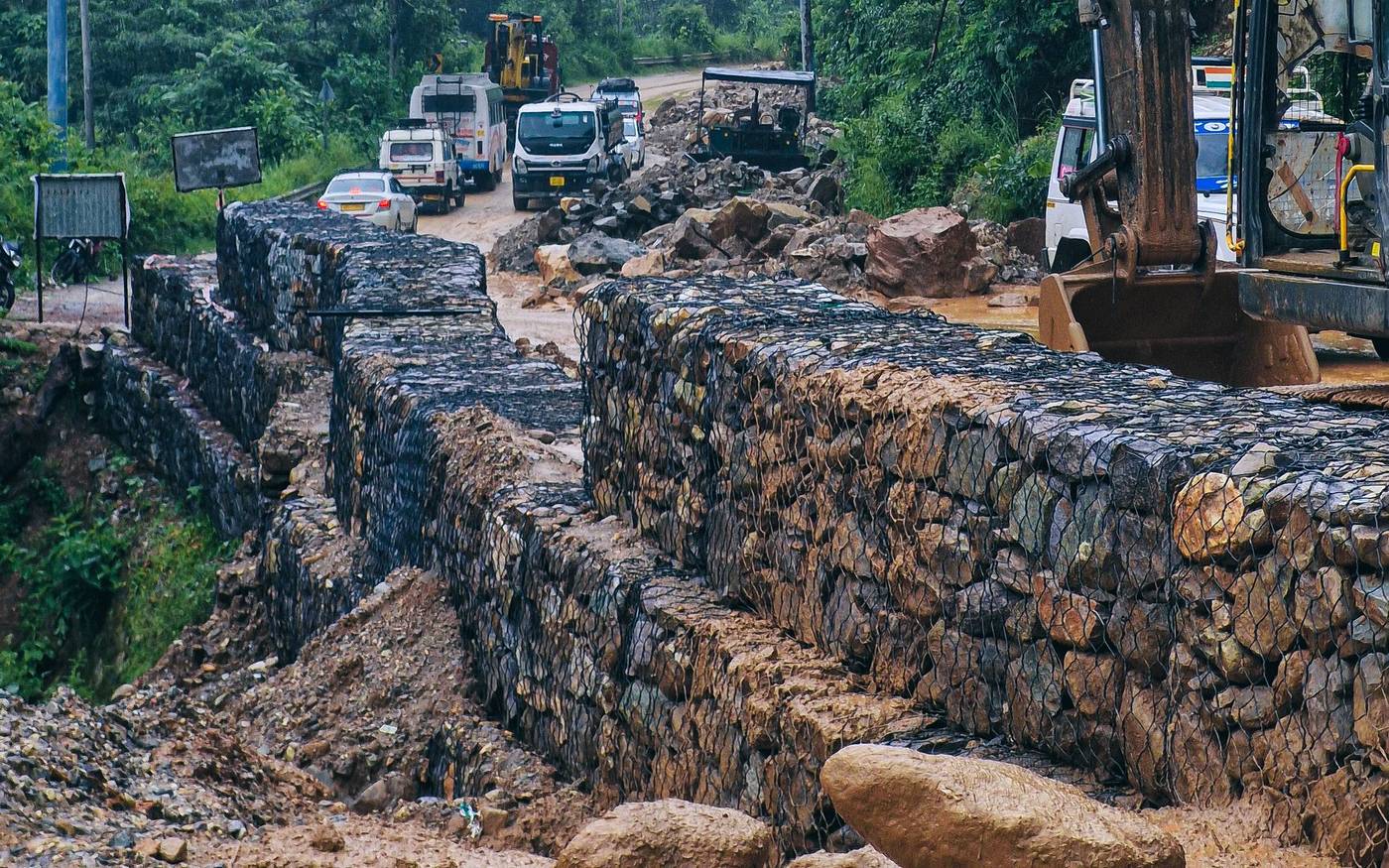
Retaining walls hold back soil, stabilise uneven terrain and create usable land on hill roads, railway formations and building sites. Built from gabion boxes, they act as gravity structures: the weight of the stone fill resists the lateral pressure of the soil behind.
Gabion walls are free-draining, so water pressure never builds up behind them, and flexible, so they tolerate settlement without cracking. They need no formwork or curing, and the fill stone is often available near the site. Where a wall must be taller than a gravity section allows, facia units with reinforcing tails take over. See the gabion wall design guide and gabion wall vs RCC.
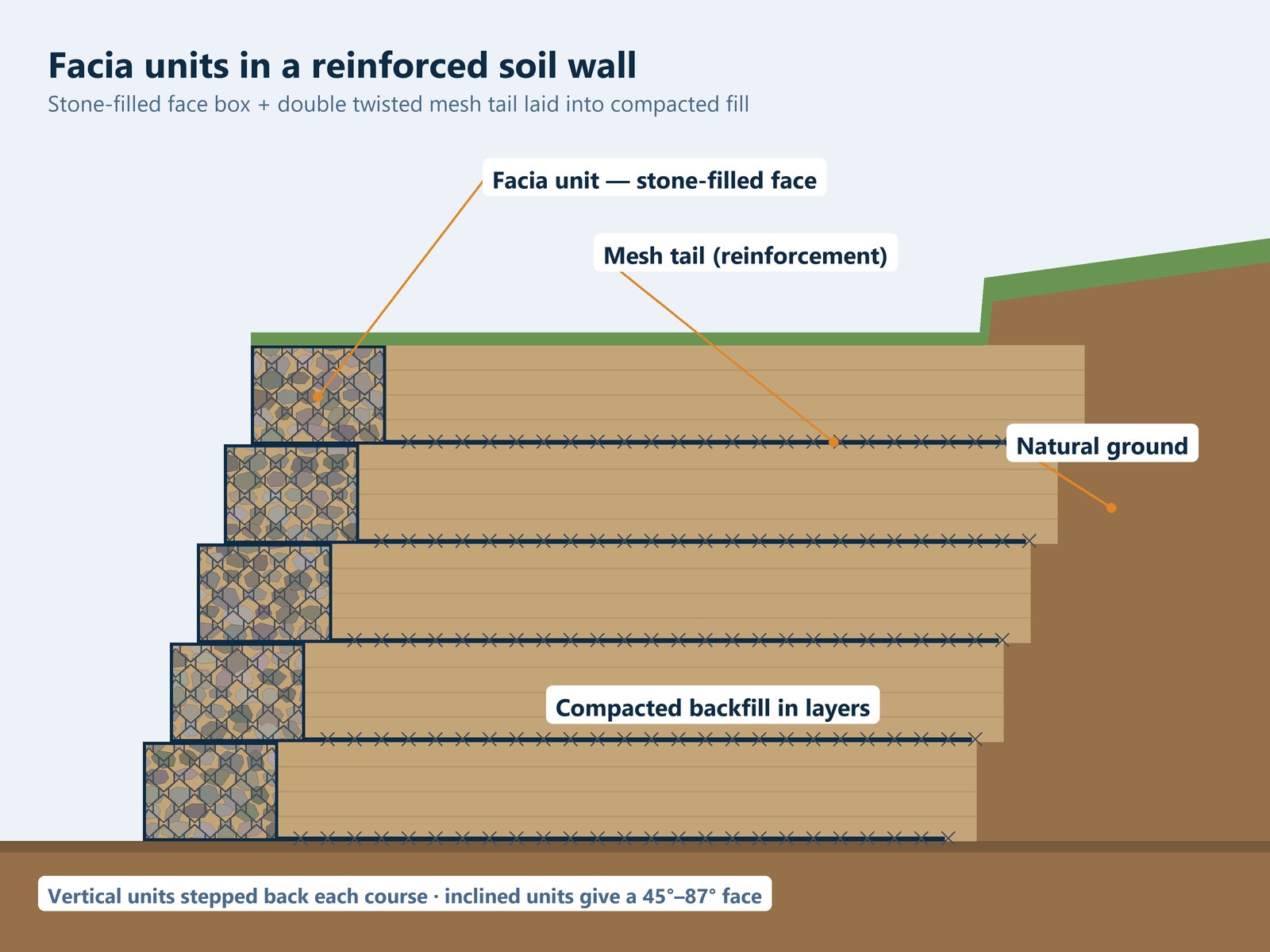
A reinforced soil structure uses the backfill itself as the retaining mass. Facia units provide the stone-filled face, and their double twisted mesh tails are laid between layers of compacted fill so soil and mesh work together.
Vertical units build stepped or near-vertical walls for road widening on hill sections, bridge approaches and embankments. Inclined units, from 45° to 87°, give a steep slope a vegetated face — and failed hillsides can be rebuilt using the displaced soil as fill.
Gabions act as soil stabilisers on embankment slopes, road cuttings and around bridge piers and abutments. As flexible, anchored mesh systems they stop soil moving under heavy rain and man-made disturbance.
Revet mattresses cover the slope face like a blanket; gabion boxes at the toe give it a firm footing, and a filter layer beneath the units stops the soil washing out through the stone.
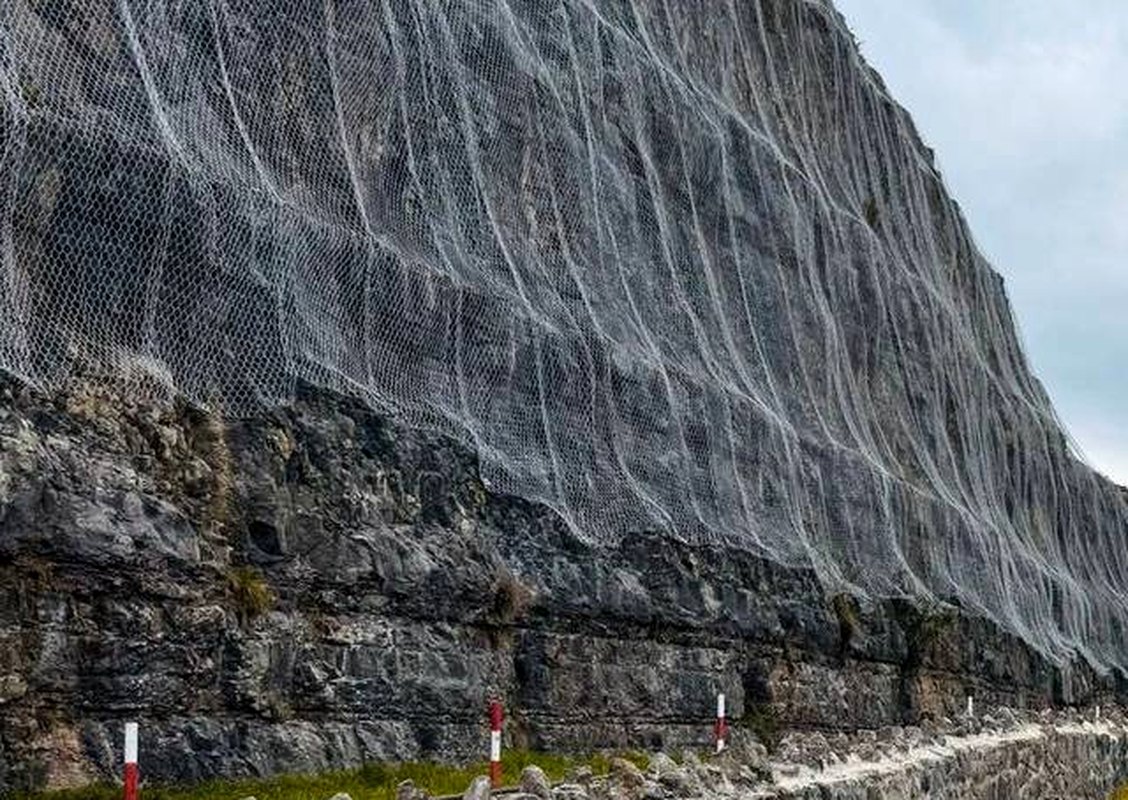
On rock cuttings above roads and railways, loose rock detaches with rain, frost and vibration. Rockfall netting draped from the crest holds it against the face and guides it down to a catch ditch at the toe, rather than letting it bounce onto the carriageway.
Because the mesh is double twisted, a wire cut by a sharp rock does not unravel the net. Rolls are joined edge to edge to cover large faces, and higher-energy slopes combine the netting with anchors and cables designed for the site.
Gabion check dams slow stormwater runoff, trap sediment and reduce soil erosion in streams and gullies, and they help recharge groundwater. They are a reliable, low-maintenance choice in all types of terrain.
The dam body is built from gabion boxes; a revet mattress apron downstream absorbs the energy of water falling over the crest so it cannot scour out the foundation. See the gabion check dam guide.
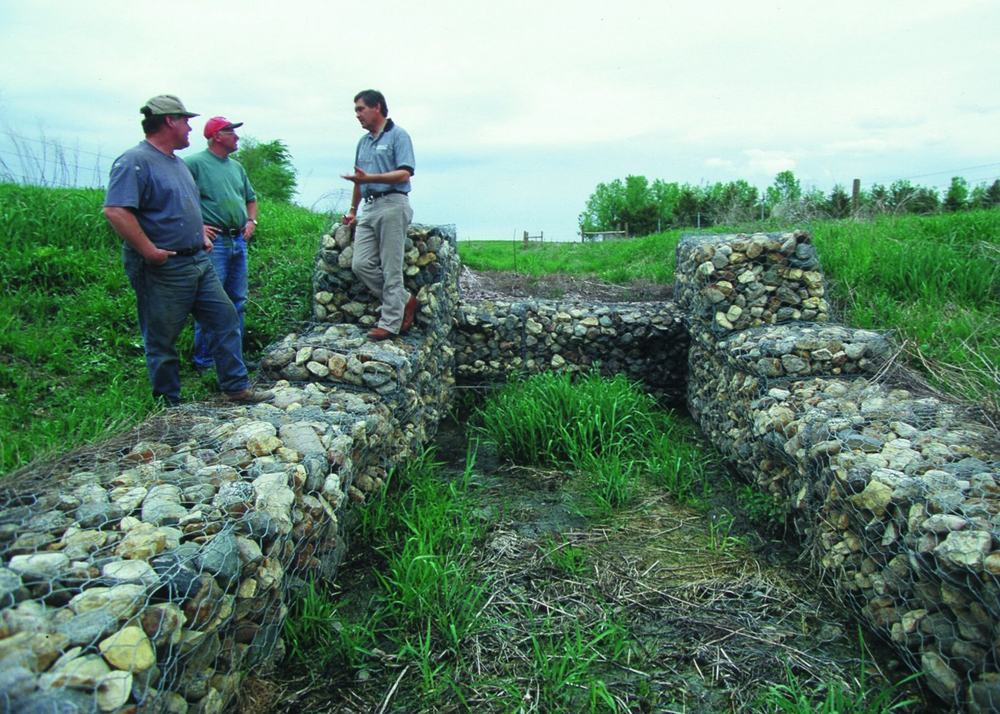 Photo: USDA NRCS, public domain
Lining canals, drains and culvert outfalls with gabions has clear advantages over concrete: the lining resists weed growth, is easier to maintain over the years, follows the channel profile and needs much less material than a concrete section.
Revet mattresses line the bed and side slopes; gabion boxes form vertical channel walls where space is tight.
Flowing water accelerates around bridge piers, abutments, spurs and culverts and digs scour holes that can undermine the structure.
Revet mattresses laid around the foundation armour the bed; gabion boxes protect abutments and wing walls; sack gabions fill existing scour holes and protect foundations below water level.
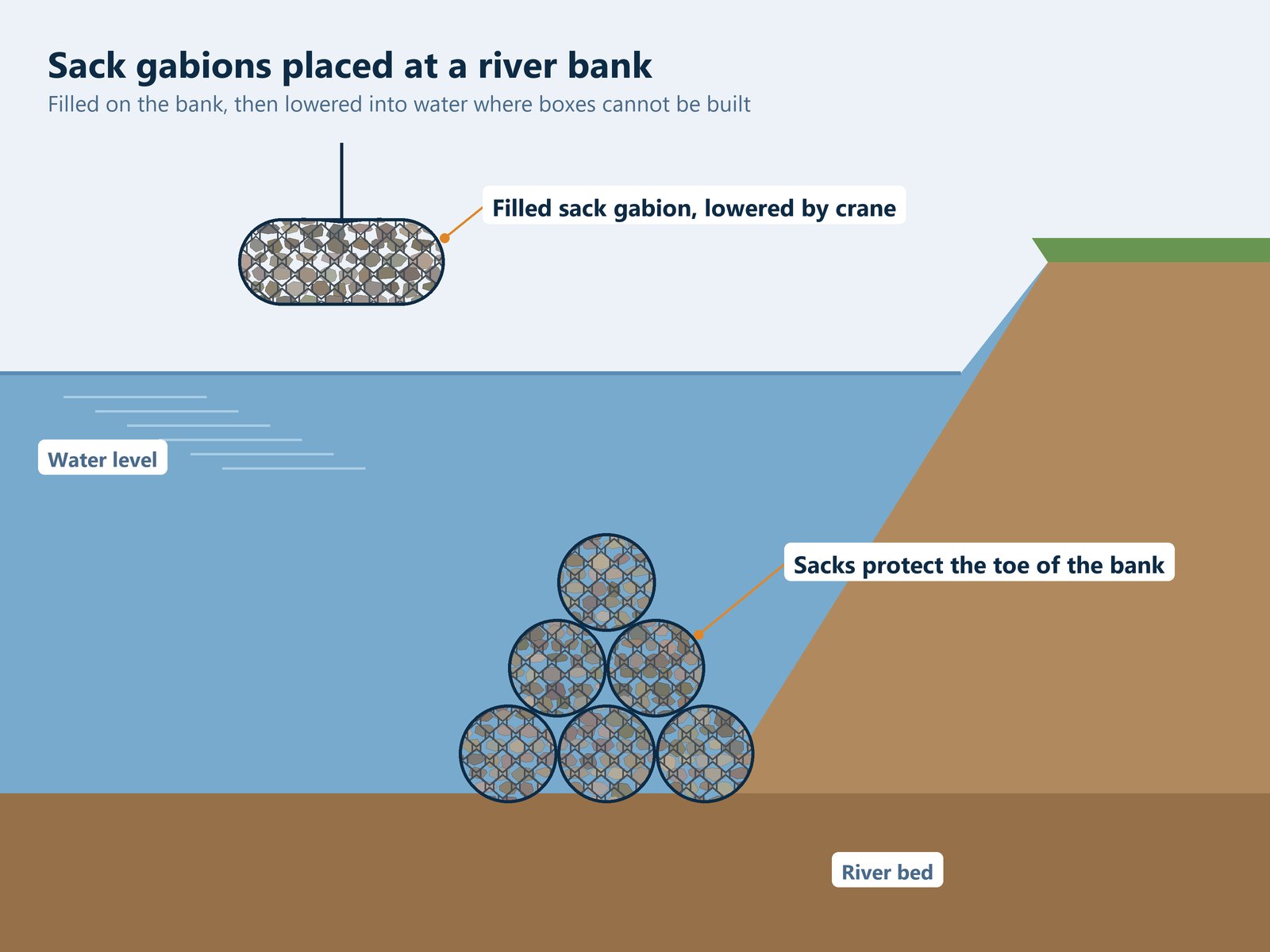
When an embankment breaches in a flood, there is no time to build boxes in the dry. Sack gabions are filled on the bank or on a barge and lowered straight into flowing water.
They close breaches, build up underwater foundations and repair scour quickly — and they conform to an uneven bed as they settle.
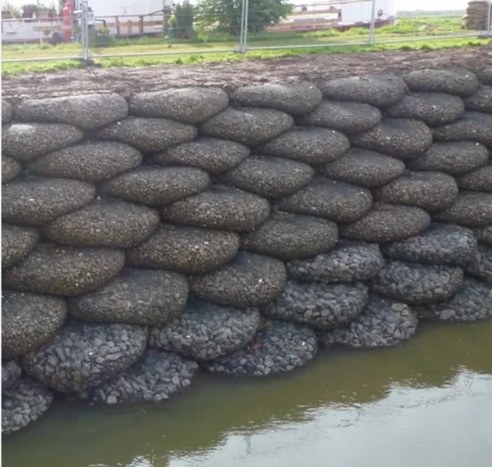
Gabion walls combine function with appearance — terraces, boundary walls, slope features and screens. Durable and eco-friendly, they support plant growth, prevent soil erosion and stabilise terrain while giving a natural stone finish.
IS 16014:2024 covers five products. Every application on this page is served by one or more of them.
Stone-filled cages stacked into gravity structures — walls, spurs, check dams.
Thin, wide units laid flat to armour a surface — beds, banks, channels.
Cylindrical units filled and placed by machine, including under water.
The face of a reinforced soil wall, tied back into the fill.
Drapery rolls anchored at the crest of a rock face.
Indicative figures from IRC:SP:116-2018 and the CWC flood-management handbook. They help with early sizing and checking a BOQ — every structure still needs a site-specific design.
Base width about 0.6–0.75 × wall height for walls up to 6 m, and 0.55–0.65 × height for 6–10 m. Embed at least 0.5 m (1 m for walls over 6 m) and give the face a 3–6° batter, or step the courses back on the outside.
Hard, durable stone 1.5–2.5 times the mesh opening, hand-packed with the long side horizontal. Aim for at least three layers of stone in a 1 m unit and two in a 0.5 m unit or 0.3 m mattress. Well-packed units reach 35–40% voids.
Chosen from flow velocity, bank slope and soil. Indicative limiting velocities: 0.17 m mattress about 4.2–4.5 m/s, 0.23 m about 5.5–6.1 m/s, 0.30 m about 5.5–6.4 m/s, and 0.5 m gabions about 7.6–8.0 m/s — then checked for tractive shear.
Laid at low water level so the units can launch down the face of a scour hole, at a slope of about 2H:1V. The apron width is sized from the expected maximum scour depth — typically 1.5 times the maximum scour depth below low water.
Where loose stones of the required weight are too heavy to handle or not available, use smaller stones in wire crates, laid with the long side down the slope and tied to each other. The mesh opening must be smaller than the smallest stone.
Poor data and design, poor workmanship (backfill and compaction not raised with the wall), badly galvanised wire, an unprepared foundation, and poorly graded or badly packed stone.
Tell us your dimensions, wire specification and quantity — we'll come back with a quotation and lead time.

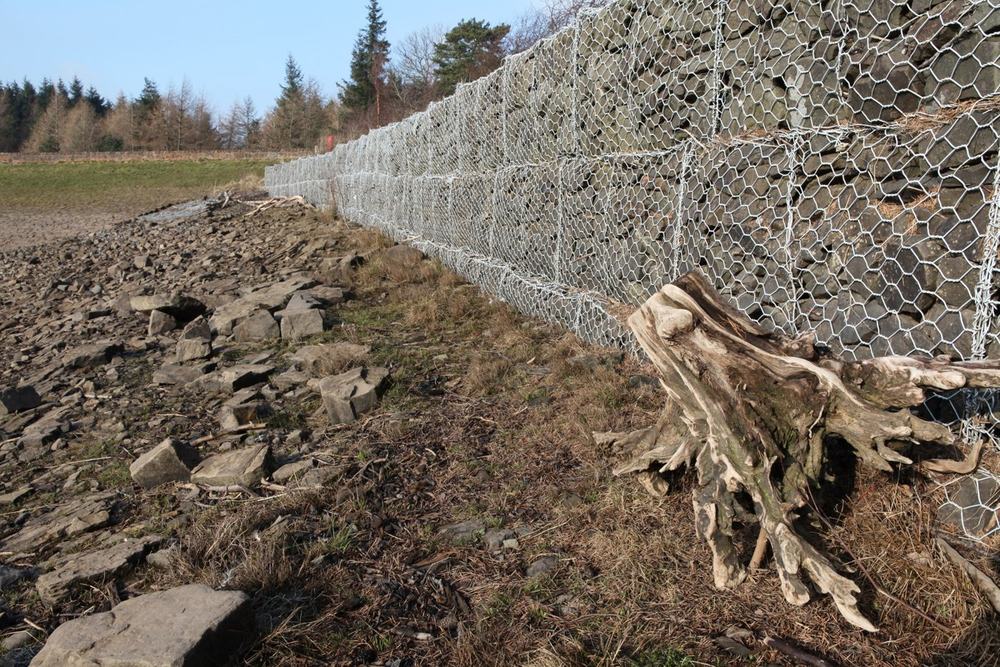 Photo:
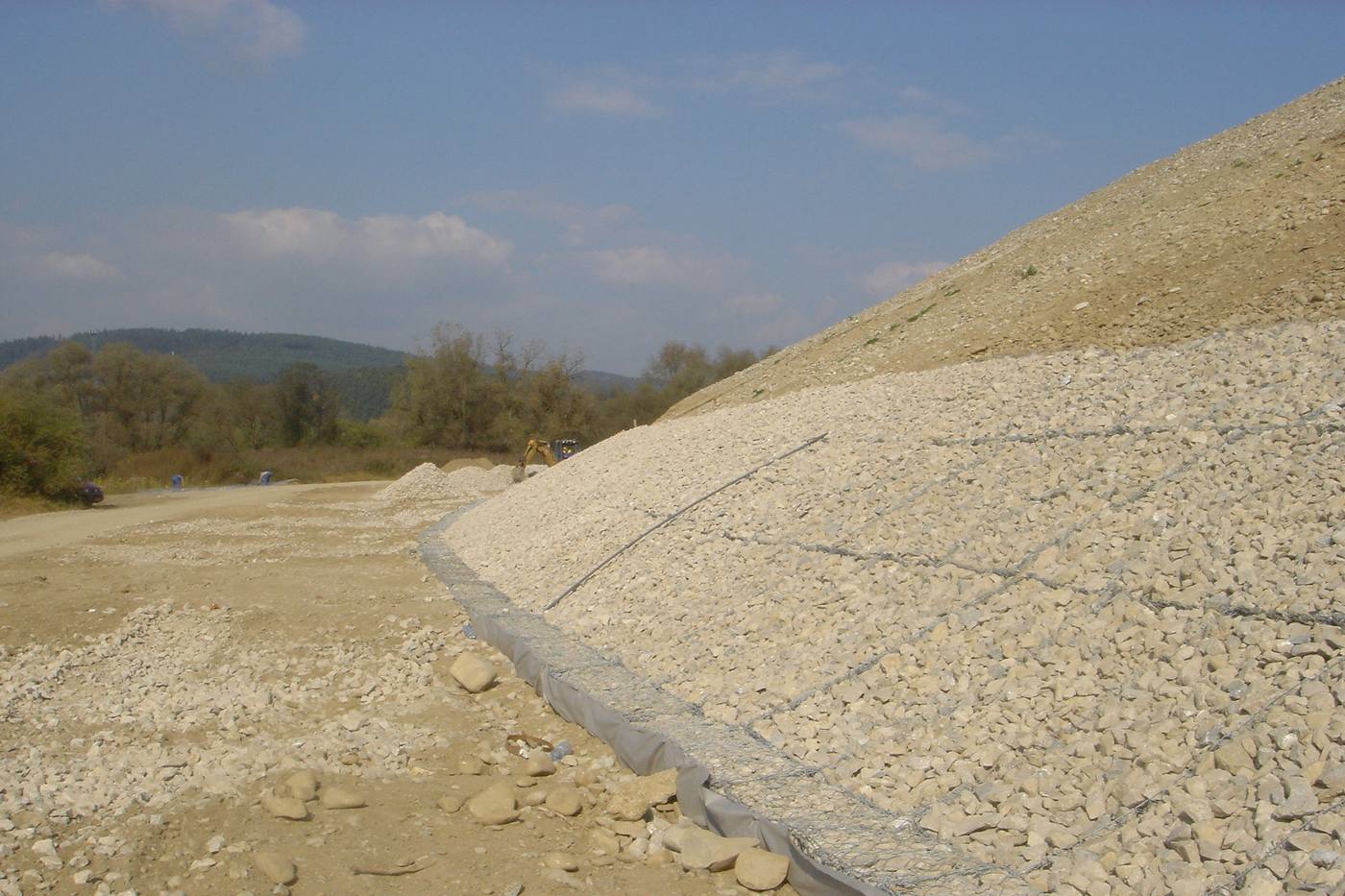 Photo: